eLearning
31 August 2026
Engage Every Charity Stakeholder with Interactive, Visual Digital Learning

In this post we look at how visual and interactive digital learning can influence different charity stakeholder groups, with examples drawn from our work with various UK and global non-profits.
Charities and non-profits don't have one audience, they have several:
-
Employees need clear internal training.
-
Volunteers need to understand your mission quickly, often in short bursts of spare time.
-
Donors need to be moved to act.
-
Policymakers need to grasp complex evidence fast, and be persuaded to do something about it.
Traditional training materials, dense PDFs, long slide decks, or spreadsheet-heavy toolkits, rarely work across all four groups at once. That's where interactive and highly visual digital learning comes in.

Done well, it can flex to suit each audience: bite-sized and mobile-friendly for time-poor volunteers, data-rich and credible for policymakers, emotionally engaging for donors, and consistent and trackable for staff.
At First Media, we've spent years building elearning for charities and non-profits that does exactly this - below is some of our own learning from this experience…
Turning complex evidence into something policymakers will actually use
Policymakers are busy, sceptical of jargon, and rarely have time to wade through a 40-tab spreadsheet, however valuable the data inside it. If your evidence isn't easy to grasp, it won't shape decisions, no matter how strong it is.
This was the exact challenge for our project on a digital toolkit for the International AIDS Society (IAS). IAS had built a powerful Excel-based tool to help countries assess HIV-related stigma in healthcare settings, but its complexity made it hard for busy policymakers and health workers to use.
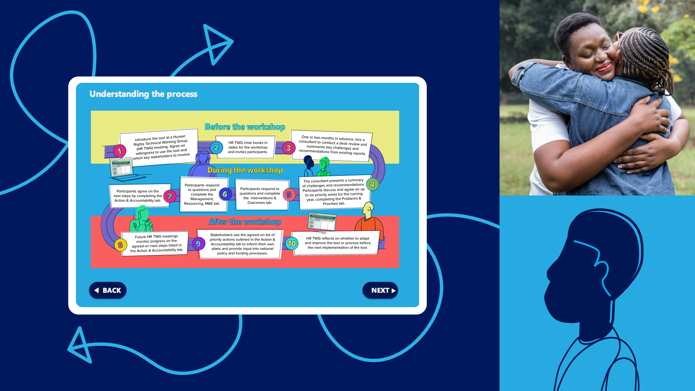
We worked with IAS to simplify the interface and improve navigation, while keeping the tool's full functionality intact.
To bring the content to life, we designed three infographics covering the political and funding case for the tool, a step-by-step usage guide, and answers to common questions. We also created an animation using continuous line art and simple, inclusive characters, a style chosen specifically to feel relatable across cultures and encourage adoption in different regions.
Crucially, the tool, infographics, and animation were all translated and voiced in multiple languages, so the message could travel as far as the cause demanded.
The result was a resource that stakeholders found genuinely easier to use, leading to faster decisions and stronger action plans, with adoption spreading across regions and helping leaders stay accountable for progress on stigma reduction.
The lesson for anyone trying to influence policymakers: strip away complexity, translate data into visuals, and make the call to action unmistakable.
Reinforcing values and knowledge for staff and volunteers
Employees and volunteers are often the beating heart of a charity, but they're also the group with the least spare time and the widest range of prior knowledge. Long inductions and dense webinars can lose people quickly. What works better is short, focused, repeatable content that reinforces core knowledge without duplicating what people already know.
That was the brief for our digital learning project with National Trust, who wanted to reinforce their core mission with both staff and volunteers, and help everyone understand the organisation's values. As they already had a suite of webinar-style modules, it was essential that any new content added value rather than repeating it.
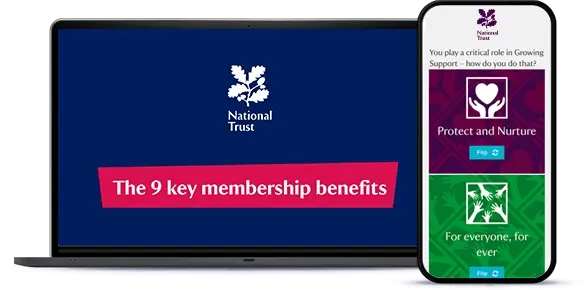
Using Elucidat as the authoring tool, we built Grow Support, a series of five interactive modules that distilled key takeaways into timelines, interactive flip cards, and knowledge checks. The bite-sized format meant staff and volunteers could work through the content in short sessions, fitting learning around their existing commitments rather than the other way round.
We also created an animation showcasing the benefits of National Trust membership, adding another layer of engaging, shareable content.
As Madeline Hilder from the National Trust put it, First Media brought original ideas from the outset about how to transform existing content into dynamic, engaging training resources, all delivered to a tight deadline.
For staff and volunteer audiences, the takeaway is that interactivity doesn't need to be elaborate. Flip cards, timelines, and short knowledge checks are simple mechanics, but they keep people actively engaged rather than passively scrolling.
Moving donors and the public with personalised, visual experiences
Donors and members of the public respond differently again. They're not obligated to engage, so content has to earn their attention, and ideally personalise the experience so it feels relevant to them specifically.
This shaped our approach to an awareness campaign with Breast Cancer UK, who needed an interactive tool to educate women and men about breast cancer prevention, an area full of public misconceptions. We developed the Prevention Hub, combining a quiz, a personalised action plan, and interactive iGuides.

The prevention quiz itself is adaptive: the next question a user sees depends on how they answered the last one, so each person's journey through the content is tailored to them. Results feed directly into Breast Cancer UK's CRM, eTapestry, helping the charity send more relevant follow-up communications and streamline its marketing.
Alongside the quiz, we built two further modules, Everyday Life and Chemicals & the Environment, using scroll cards, custom illustrations, and interactive hotspots to present sensitive, sometimes difficult information in a clear and approachable way.
Breast Cancer UK's CEO, Thalie Martnini, said First Media's creativity had enabled the charity to personalise and bring breast cancer prevention to life for its audience.
For donor and public-facing content, the principle is that personalisation and interactivity work together. A quiz that adapts to the user, paired with visuals that make a difficult subject approachable, does more to change behaviour than a static awareness page ever could.
One toolkit, many audiences
What connects these three projects is a shared belief that different stakeholders need different formats, but the same underlying craft: clear visual storytelling, purposeful interactivity, and content built around how people actually behave, whether they're a policymaker with ten minutes between meetings, a volunteer learning on their phone, or a donor deciding whether to act.
If your charity or non-profit is looking to engage employees, volunteers, donors, or policymakers more effectively, our elearning for charities and non-profits could help - contact us to talk through what's possible.
You could also take a look at our work with the International AIDS Society, the National Trust, and Breast Cancer UK for more detail on how interactive, visual learning can be shaped to fit your audience.


Why choose First Media?

Improve your overall performance
Get high-quality creative, eLearning faster and stand out from the competition.

Become more agile and responsive
We deliver engaging, high-quality training and support wherever you are and whenever you need it.

Elevate your team
Our in-house team of designers will work with you every step of the way to ensure you get the right look.

Captivate your audience
We combine novel ways to appeal to our learners natural curiosity and engagement.
Make your ideas come to life with First Media.